


You can get skins in CS2 in several ways. Most often you can find references to rare skins falling out of cases, as well as their purchase on the Steam trading platform or third-party services. However, there is another method, which also works quite well, although it is used less often due to its complexity and less predictable results.
What are contracts?
Contracts (TradeUpContract) are a mechanic in CS2 that allows you to exchange 10 skins of the same quality for one of a higher quality. In this case, the characteristics of the resulting item are determined taking into account the parameters of the skins selected for such crafting.
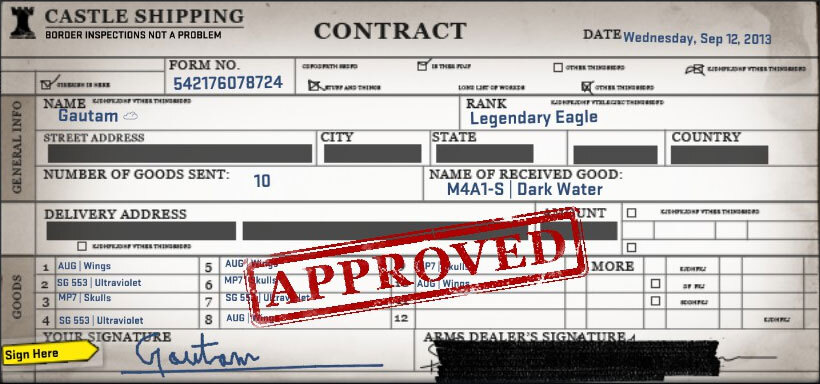
Keep in mind that you cannot mix items with and without a StatTrak counter: all skins must be the same in this respect. Accordingly, it depends on this whether the resulting craft will have a counter. Knives and gloves themselves cannot be used in contracts. A standard contract can give skins of up to Covert rarity, and since October 2025 exactly five Covert skins of one type (all regular or all StatTrak) can be traded up for a random knife or gloves from the collections of the inputs.
How are skin parameters determined when crafting?
The properties of the skin that will be obtained as a result of crafting are determined randomly, but taking into account the parameters of the ten skins that were selected for use in the contract.
- Its quality will be one level higher (for example, from ten Consumer Grade skins you can get one Industrial Grade skin).
- If all ten skins belong to the same collection, then the result will also belong to it.
- If skins from several collections are added to crafting, there is a chance of getting an item belonging to any of them.
- The Float indicator is determined by a formula that takes into account the average value of this characteristic for ten initial skins and the possible range of the resulting one.
To increase the likelihood of getting the right item, it is useful to know the composition of different collections and the rarity of the items they contain. If several options match the characteristics of the resulting skin (collection, rarity), their dropout is equally likely. It should also be taken into account that since the market price of the skin in crafting is not taken into account, you can end up either in the black or in the red: there are also situations when the resulting skin costs less than what was spent on its creation.
Although the outcome of crafting remains unpredictable, it is a good way to get at least some use out of the cheap skins you accumulated during the game. And if you understand in detail the patterns of item drops as a result of contracts, you can successfully replenish your inventory and gradually make your way to expensive skins. You can experiment with this mechanic using one of the many crafting simulators that are available on the Internet. And if you already know exactly what skin you need, it’s better not to rely on chance and buy it directly on LIS-SKINS. We promise that our prices will not disappoint you.
