


Beginners are quite often interested in what skins can drop in CS:GO after a game, and whether it’s realistic to get an expensive exclusive item almost at the start of your esports journey. If you set aside probability theory, margin of error, percentages, and complex math models — you could even get a Dragon Lore in your very first match, as long as you're playing on official servers. Only there can you get not just crates, but also actual skins as drops.
But let’s come back to earth. If the drop rate for covert or even classified weapons were around 3-5%, the entire in-game economy would collapse, and today's $30,000-50,000 items simply wouldn't exist. For Valve, CS:GO is one of the most profitable tools for monetization and promotion of the Steam platform. So don’t expect any indulgences or increased chances from good old Gabe.

Community experience shows the approximate post-match drop rates are as follows:
White (consumer grade) — about 76%
Blue (industrial) — 18%
Blue (mil-spec) — 4%
Purple (restricted) — 1%
Pink (classified) — 0.2%
Red (covert) — 0.0005%
These numbers aren’t official, but over years of active CS:GO play, community consensus has formed. Note: we’re talking about skins, not cases — those need to be unlocked with a key.
As for cases, drop chances are approximately:
Blue — 80%
Purple — 15%
Pink — 3%
Red — 0.6%
Gold — 0.25%

Not exactly exciting odds.
And don’t forget — in CS:GO, besides skins, graffiti can drop after matches. That means nearly a 50% chance of receiving a non-weapon item. And seeing a valuable spray? Practically impossible. It’s easier to just buy one for $0.20-0.27, since demand is low.
What You Should Not Expect From Random
Even if you regularly level up and rank up, earning rewards from Valve, there are items you’ll never receive randomly — not even on official servers:
Any StatTrak items (case-only);
Knives;
Gloves;
Most sticker and graffiti capsules (only 10% are freely available);
Gold-tier items;
Collectible skins.
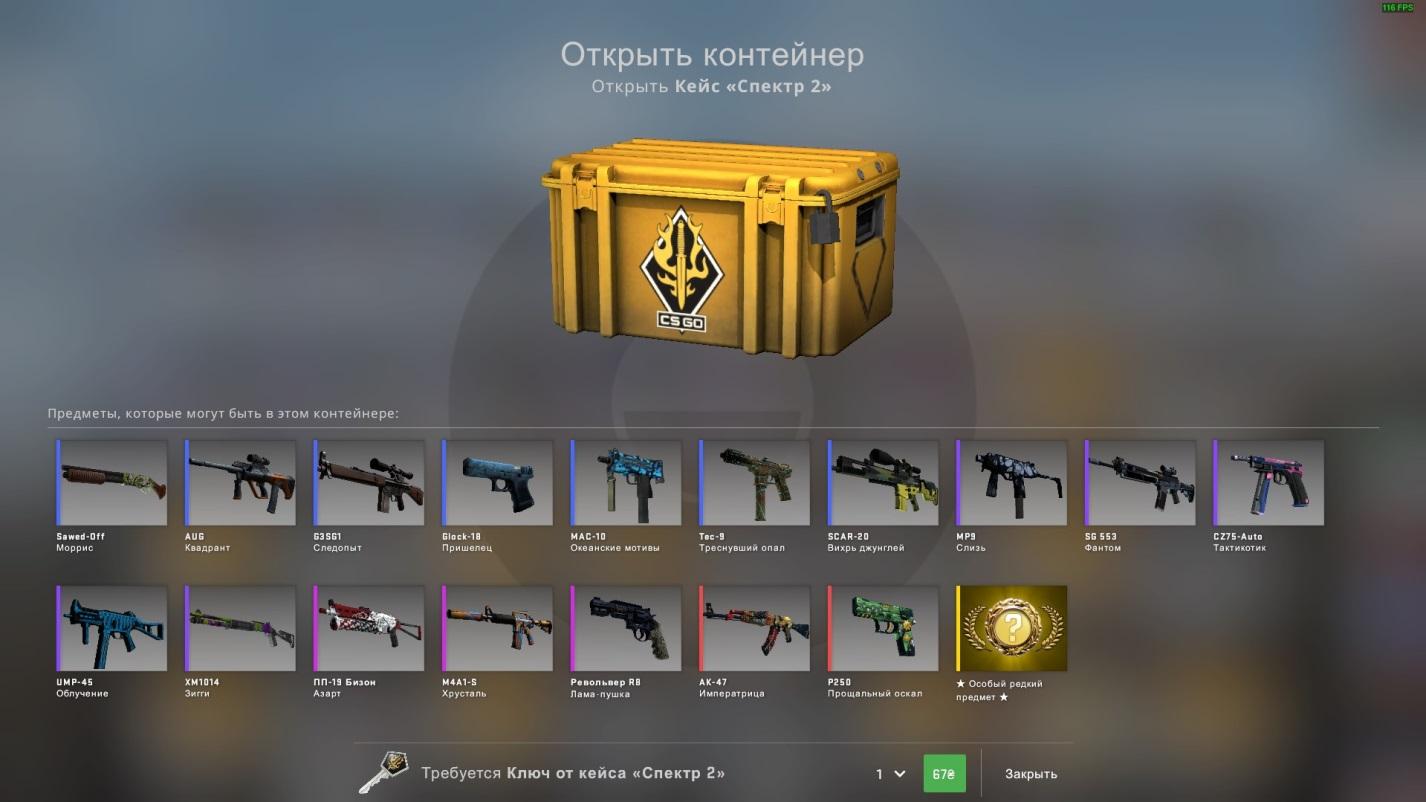
Most often, players receive skins from the 5 most recent collections. Drops from older collections (like Bravo) are extremely rare.
Speed and Frequency of Drops
There’s a myth that you can get no more than 4 skins per week. In CS:GO the drop system really did slow down: the more you played, the longer it took to receive your next item. CS2 works differently: Prime accounts get a weekly Care Package when they level up and choose 2 of 4 offered items, which can include cases, graffiti and weapon skins.
Unclaimed choices do not carry over to the next week, so it pays to claim the reward every week.
Can You Increase the Drop?
If you play fair, there is no legal way to “force” extra drops: there is one weekly reward, and it never gives more than two items. Keep in mind that in CS2 weekly drops are available only to accounts with Prime Status.
The weekly cycle resets on Wednesdays at around 01:00 UTC (4:00 AM MSK).
Important: only official servers protected by VAC count. Any cheats or mods — and your account + inventory will be banned in seconds.

You can speed things up with paid content: in CS:GO it was operations like "Shattered Web" or "Operation Riptide", and in CS2 their place has been taken by the paid Armory Pass. Either way, it takes time and effort.
Profitability of Skins
So, is it all worth it? For new players — definitely. Even gray and blue skins look better than stock ones. For example, the MAC-10 Indigo or P90 Storm — basic but nice.
For veterans, however, it’s better to focus on either rare cases or trading. That’s where LIS-SKINS Market comes in — a place where you can find top-tier skins, agents, stickers, knives, and more at great prices.
Got extra junk in your inventory? Sell it, transfer the money to your LIS-SKINS balance, and buy that one skin you’ve always dreamed of.
