


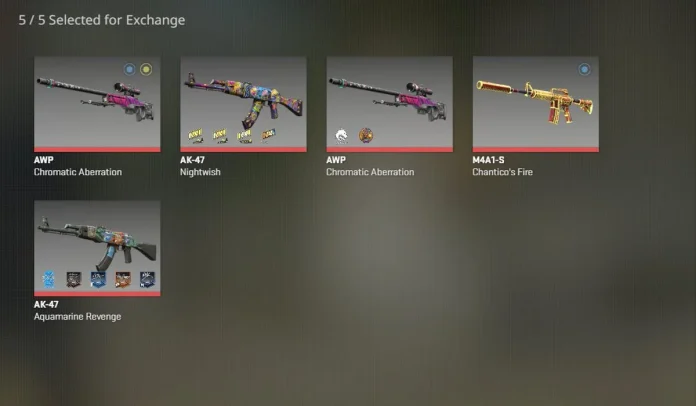
A trade-up contract in CS2 is a built-in mechanic that turns 10 skins of one rarity into one skin of the next rarity from the same collections. For example, 10 blue (Mil-Spec) skins give one purple (Restricted) skin, and the exact result is picked at random from the possible outcomes. Since the October 2025 update, there is also a recipe for the top tier: 5 Covert skins can be traded up into a random knife or pair of gloves.
Below we cover the contract rules, how odds and float work, what real trade-ups cost at current prices, the mistakes beginners make and how players build good-looking skins with stickers.
How Does the Trade-Up Contract Work in CS2?
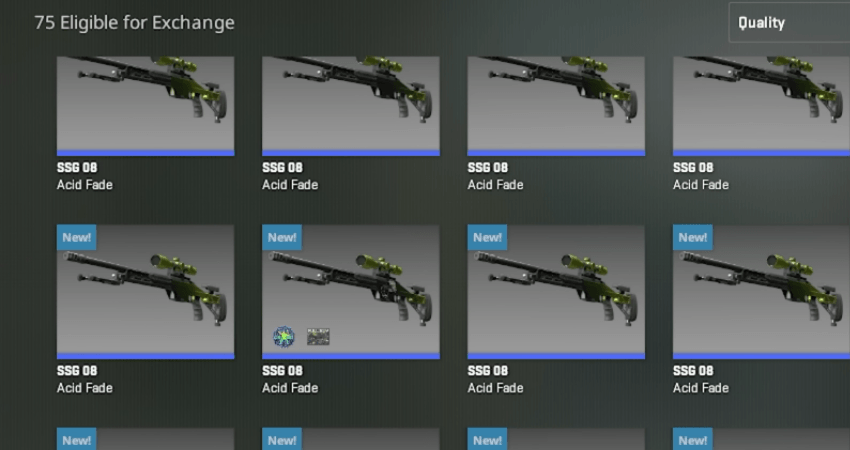
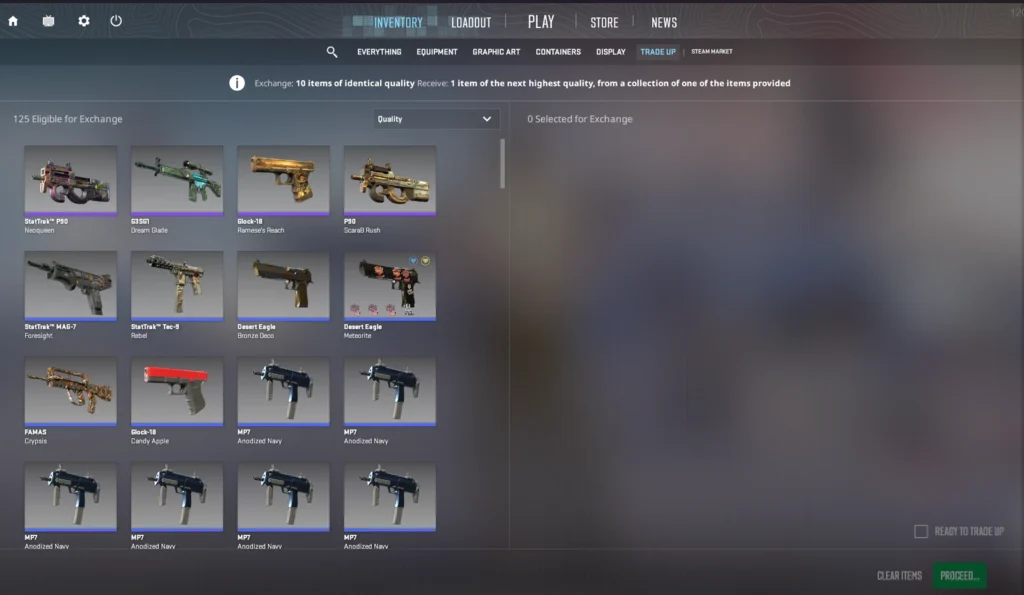
The trade-up contract in CS2 is an in-game system through which a player can obtain a rarer skin using ten items of the same rarity level. This process is based on Valve's official mechanics and implemented directly in the game interface, without third-party modifications or plugins. Essentially, it's a method of "crafting" — replacing old, less valuable skins with one potentially expensive one from the next rarity tier.
To activate a contract, you need to open the "Inventory" tab, select ten suitable items, and click "Use in Trade-Up Contract." After confirming the action, the system randomly selects a result from all possible skins that fit the conditions. And it's precisely this element of randomness that makes CS2 trade-up contracts not only interesting but also risky — since the chance of getting a truly rare weapon is small.
How the trade-up contract works in CS2 on a technical level: each of the ten added items has a specific collection and quality level. When they're all combined, the game determines which collections are participating and selects the final result based on probability. If all items belong to one collection, the final skin will be guaranteed from it. If collections differ, the chance depends on how many items come from each collection and how many next-tier skins each collection has.
For example, if a player uses 6 skins from The Control Collection and 4 from The Ancient Collection, and each of those collections has one possible next-tier skin, the probability of getting the item from the first collection is 60% and from the second 40%. This makes contract mechanics strategic: the outcome depends on collection choice.
Here are the main rules established by Valve:
Only weapon category items are used — agents, stickers, and capsules are excluded.
All ten items must be of the same rarity level (for example, all blue, purple, or pink quality).
You cannot mix regular and StatTrak skins: if every input is StatTrak, the result is StatTrak too.
The wear (float) of the inputs affects the wear of the result, but not which skin you get.
Each contract creates a moment of uncertainty. It's precisely this feeling of chance that makes the trade-up contract in CS2 exciting. A player can get a skin worth $200 or an item costing only $3 — everything depends on the collection and luck.
Trade-ups for knives and gloves
Since October 2025 you can put exactly 5 Covert skins into a contract: all regular or all StatTrak, no mixing. The result is a random knife or pair of gloves from the cases and collections the input skins belong to. Details and examples are in our complete guide to crafting knives and gloves in CS2.
What Types of Contracts Exist?
Players engaged in crafting conditionally divide contracts into several types. The first is regular crafting from droppable collections. These are cheap collections whose skins are widely available on the market (for example, The Italy Collection or The Train Collection). The second is crafts from rare operation collections (for example, The Control Collection), which do not come from regular drops now. The latter are considered more valuable, and they often form profitable CS2 trade-up contracts.
There are also so-called "mix contracts" — when a player adds items from different collections. In this case, the final skin can come from any of them, and the odds depend on how many items from each collection are in the contract.
What Affects Contract Results?
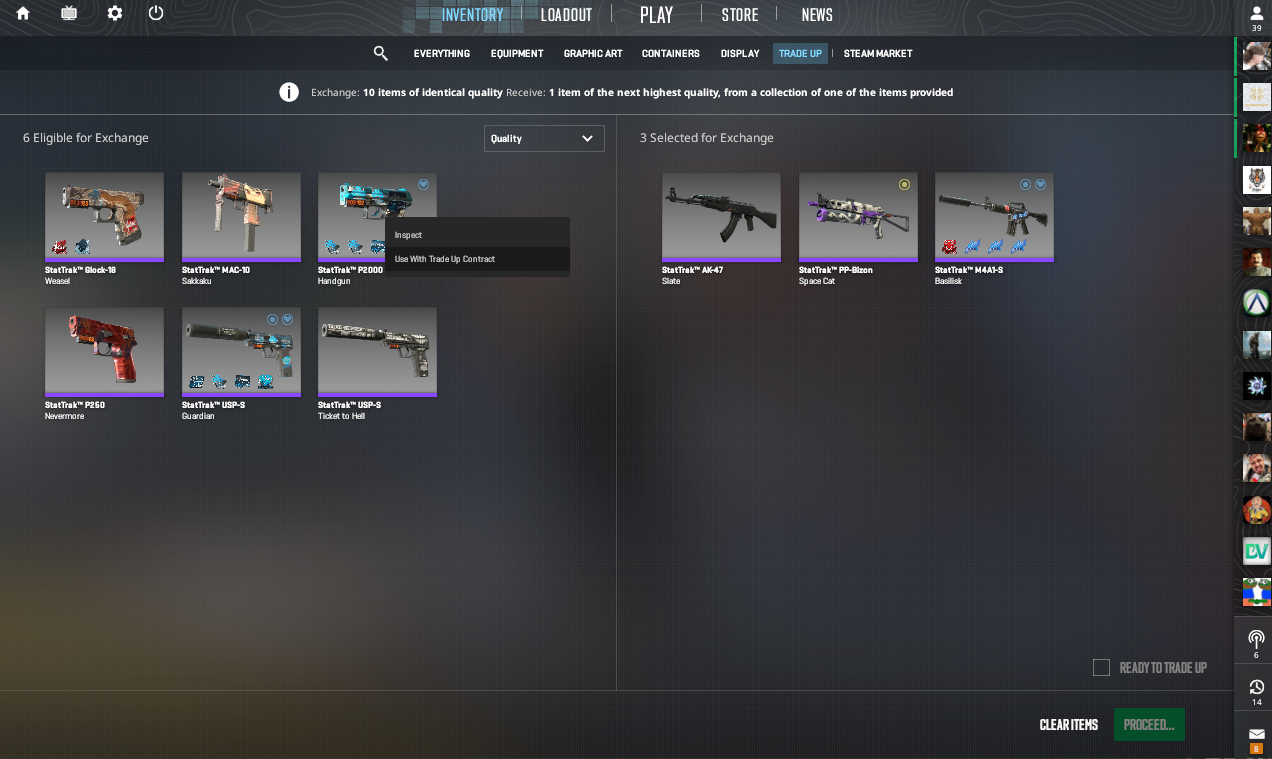
The main thing to remember: craft outcome doesn't depend on the cost of added items but is determined exclusively by collection and rarity. If items from different collections participate in the contract, the chance of getting a skin from each will be proportional to the number of added items.
Example: 5 items from The Control Collection and 5 from The Ancient Collection give a 50% chance for an output skin from each.
It's also important to understand float mechanics — a parameter affecting skin condition. The final float depends on the average float of the inputs and on the float range of the skin you receive. If you want a Factory New result, use low-float inputs, usually below 0.07, and check the float range of the target skin. We explain wear in detail in our CS2 float and wear guide.
Which Contracts Are Considered Most Profitable?
Some of the most profitable trade-up contracts in CS2 can be assembled with proper calculation. Most often, we're talking about crafts of skins from collections that don't drop in matches and aren't available in regular cases. Classic examples:
AWP | Desert Hydra (The 2021 Mirage Collection).
AK-47 | Panthera onca (The Ancient Collection).
Right now AK-47 | Panthera onca costs from about $110 in Battle-Scarred to about $330 in Factory New, and AWP | Desert Hydra from about $950 to about $1,350. Getting them takes an investment: 10 Restricted skins from The Ancient Collection in Field-Tested cost about $200 to $250, and the result is either Panthera onca or P90 | Run and Hide. Desert Hydra needs 10 Classified skins from The 2021 Mirage Collection, which means $1,200 or more. That is why you should always calculate and compare.
How Much Does a Contract Cost? Real Example
Here is a trade-up for M4A1-S | Blue Phosphor from The Control Collection. It is a Classified skin, so the inputs are 10 Restricted skins from the same collection, for example UMP-45 | Crime Scene in Factory New:
| Input skins | Quantity | Price per unit | Total |
|---|---|---|---|
| UMP-45 | Crime Scene (Factory New) | 10 | ~$75 | ~$750 |
Prices are approximate LIS-SKINS prices and change daily.
The Control Collection has two Classified skins, so it is a 50/50: M4A1-S | Blue Phosphor (about $520 in Factory New) or USP-S | Target Acquired (about $330). The average result is about $425 against an outlay of about $750, so at current prices this contract loses money. That is exactly how to check any of the best CS2 trade-up contracts before you craft: the chance of getting a specific item is far from 100%.
Popular Collections for Crafting
Some players spend years studying collections to find the most valuable skins for crafting. A kind of "top" has formed within communities:
Before moving to the list, it's worth noting that the main popularity criterion is the combination of collection unavailability, rarity of final items, and their visual appeal.
Most sought-after collections:
The Ancient Collection: popular for AK-47 | Panthera onca.
The Norse Collection: for AWP | Gungnir (from about $6,950 to about $12,000).
The Control Collection: with unique finishes on M4A1-S.
The Canals Collection: thanks to purple and pink skins.
The 2021 Mirage Collection: includes AWP | Desert Hydra.
It's from these collections that expensive CS2 trade-up contracts are often assembled.
Are There Risks with Trade-Up Contracts?
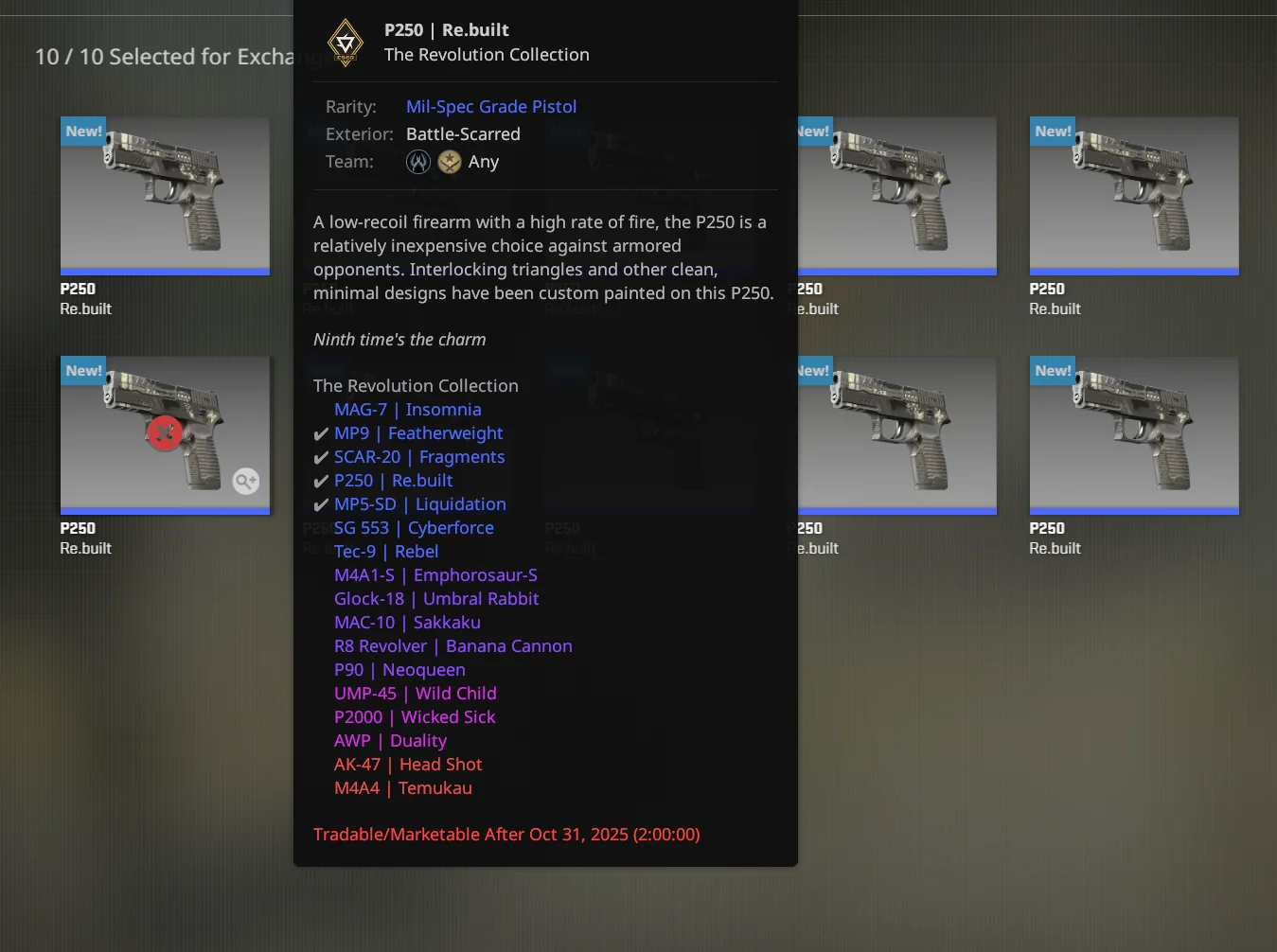
Risks when using trade-up contracts in CS2 really do exist — and they're much higher than they might seem at first glance. Despite simple mechanics and potential opportunity to earn or get a rare skin, the outcome most often depends not on calculations but on probability, which is impossible to control 100%. Even with a perfectly composed contract, a player can spend $100 and get an item worth a fraction of that. This isn't an error or bug — it's the essence of a gameplay system based on randomness.
The main problem is inflated expectations. Beginners often think that by investing more expensive skins in a contract, they'll definitely get a valuable result. In reality, the chance of a specific item dropping can be only 10% or even less. Moreover, remember: the game doesn't analyze item market value — it only sees collections and rarity. This means a $1 skin and a $25 one from the same rarity category and collection participate in the contract on equal terms.
This becomes especially critical when a player does CS2 trade-up contracts from mixed collections. If collections differ, the odds depend on the number of items from each collection. For example, with the same number of possible outcomes in each collection, if the contract has 7 skins from one and 3 from another, the drop chance from the first collection is 70%, and from the second — 30%. And if there's a collection with cheap output skins among them — the probability of getting an insignificant item sharply increases.
Here are common mistakes players make:
Before moving to the list, it's important to emphasize: most of these mistakes are related not to ignorance of mechanics but to ignoring market analysis, probabilities, and calculations. Even experienced traders sometimes make mistakes when acting spontaneously.
Adding items from different collections to the contract without considering how this affects the chance of getting the desired result. As a result, you get the wrong skin you were counting on.
Using items with high float — this is a wear parameter. If the average float of the inputs is high, the result can come out Battle-Scarred even if you were counting on Factory New.
Not calculating the market before crafting, focusing only on visuals. A beautiful skin can be cheap, while an ugly one — expensive. In contracts, it's not style that wins but mathematics.
Mixing StatTrak and regular skins or skins of different rarities: the game simply will not accept such a contract.
Focusing only on input item cost, forgetting that even expensive ingredients don't guarantee expensive results — especially if they're from unpopular collections.
After performing each of these actions, many players regret spent money. And this isn't surprising: mistakes are costly, especially when it comes to profitable CS2 trade-up contracts, where the count can go into tens or hundreds of dollars.
How Are Beautiful Crafts Made?
Not all players strive to extract profit from crafting. For many, the trade-up contract in CS2 is primarily a method of self-expression, a form of digital creativity where each skin becomes a canvas. Such users — collectors, aesthetes, enthusiasts — approach combination selection with utmost attention, achieving visual perfection. In this category, what matters isn't price but image, style, and individuality.
Visual crafts are usually built not only on base weapons but also on thoughtful stickers. Players select skins with specific palettes, texture shapes, or compositions, to which a sticker is then "attached," enhancing the aesthetic effect. This approach takes both taste and money: the stickers often cost more than the skin itself. For ideas, see our list of the most beautiful stickers in CS2.
The following styles are most often used:
Before listing, it's worth clarifying: these approaches have become standards within the community, and today it's precisely by these schemes that expensive "visual crafts" are built, which then participate in deals between collectors, appear in streamer inventories, and even figure in investment portfolios.
Full craft — genre classic. Four identical stickers, usually foil or holographic, are placed on all available slots. Perfectly suited for skins with dark bases where sticker emphasis is especially noticeable. Example: AK-47 | Redline (from about $20) + 4x Crown (Foil) (about $330 each).
Corner craft — single expensive sticker placed in bottom corner. This composition emphasizes uniqueness without overloading appearance. More often applied to AWP, Desert Eagle, or M4A1-S. Especially appropriate when using limited stickers — for example, Katowice 2014 or Krakow 2017.
Symmetry craft — vertical or horizontal symmetry. Arranged on "2 top, 2 bottom" principle or "2 left, 2 right." Used mainly on skins with centered design to not cover main elements.
Minimal craft — new trend. Only one or two stickers matched by color to the weapon. This emphasizes minimalism, and often this approach looks even more expensive than a fully stickered skin.
Should You Even Do a Contract or Sell the Skins?
Everything depends on the goal. If the goal is to get a rare skin in good quality with a chance to earn — yes, it's worth it. If saving money matters more, it may be better to sell the skins one by one and buy the one you need. How crafting compares with buying is covered in our article on what skin crafting in CS2 is.
Contracts bring excitement and emotions but not always profit. It's like a lottery: you can hit the jackpot or get the cheapest possible option. Therefore, profitable CS2 trade-up contracts are more the exception than the rule.
Conclusion
In the CS2 world, the trade-up contract remains one of the most exciting and ambiguous mechanics. It combines excitement, calculation, and visual creativity. A player can create a unique skin or simply waste money — everything depends on approach.
Experienced crafters know: before any contract, you need to evaluate entry cost, success chance, float, visual style, and market. Only then can you do CS2 trade-up contracts that truly satisfy — and not just empty your inventory.
