


The largest fraud scheme in Steam history is usually linked to a case that came to light in early 2023: an outsourced Steam support employee and an accomplice used the account recovery process to take over abandoned accounts with expensive skins, cashing out more than $320,000 in a year. Below is how the scheme worked, how it was uncovered and what buyers of expensive items can learn from it.
A certain user under the nickname Steam Help had been known in the gaming community for some time. People said he had a contact in Steam support and could therefore get the data of any account. In a series of videos dedicated to this case, YouTuber Mzkshow mentions that some players turned to Steam Help for help in restoring their game profile, and he, as confirmation of his capabilities, sent them account information that could not be obtained in any other way.
Later, new information emerged about this person, whose real name remains unknown. It turned out that Steam Help was not an intermediary, but was a support employee. He conspired with another person who appears in the Mzkshow video as Alexander, and they used the existing mechanism for restoring access to the account for their own purposes.
How did the fraudulent scheme work?
By contacting Steam support, a user can regain access to their profile even after losing access to the linked email. To do this, you need to confirm your identity and provide as much detailed information as possible, for example, the first key that was activated on your account. Let's imagine a hypothetical situation where two people are trying to gain access to an account: a scammer and the rightful owner. Each of them tries to prove that the account belongs to him by providing some information. Most likely, support will give priority to the one who provides more information. That is why protecting your account data matters, as we explain in our guide on how to protect your inventory from scammers.

This is the mechanism Steam Help and Alexander exploited. Fraudsters targeted accounts that had expensive items in their inventory. At the same time, they selected those profiles that had been inactive for many days or had once changed ownership. Using the account data Steam Help had access to, they went through the procedure of restoring access, after which they sold items and deleted the account. The amount they managed to withdraw in this way during the year amounted to more than 320 thousand dollars.
The illustration below shows an example of what the user information window might look like in a support employee's interface.
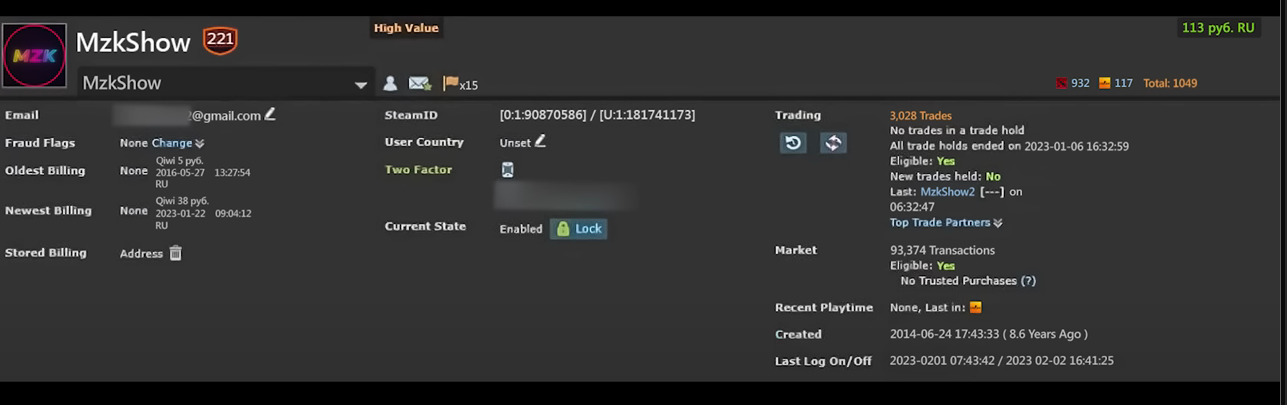
It also turned out that these two were not the only ones using the mechanism. Mzkshow notes that at some point Alexander and Steam Help ran into "competitors": someone managed to pull items from the accounts they had targeted before they could.
What did Valve do?
The existence of such a scheme was possible due to the way the support of Steam is organized. Due to the fact that the number of players is extremely large and they are located in different time zones, Valve outsources the resolution of all typical issues, and the second level of support (Valve directly) deals only with atypical and complex situations. It was in one of these outsourcing companies that Steam Help worked. This can be indirectly confirmed by the fact that, according to Mzkshow, Valve recently severed relations with one of the outsourcers, and a number of employees were fired from there. The blogger suggests that it could be the company CPL.

Even if users noticed that something suspicious was happening to their account, they were unable to dispute the loss of items and regain access, since the information that the scammers could provide to support was always more complete. This went on until they tried to take over the account of a user who had some connection with Valve himself. He got his account back, and the outsourcing company was audited. Other high-profile cases are collected in our overview of the biggest hacks in the skin market.
Most of the skins that the scammers managed to get ended up with collectors, including, for example, Anomaly. And one of the items featured in this story, the M4A4 Howl, was spotted in 2023 in the inventory of B1T from NAVI. However, the current owners can hardly be blamed: they clearly did not know they were buying stolen items. If you buy expensive items secondhand, check their ownership history in services that track float values and account changes. If it shows that the item sat for a long time on an account that has since been deleted and then changed hands, you may be looking at a skin that passed through the scammers.
Today CS2 has an extra safeguard: since 2025 any trade can be reversed within 7 days, as explained in our article on Steam Trade Protection. To avoid losing items to swapped trade offers, it also helps to know what a Steam API scam is.
