


Counter Strike: Global Offensive – It’s a team game, which means that to succeed in it you need to know the roles of the players and act in concert. In order not to just try to randomly defeat an opponent, but to be able to implement a targeted strategy, it is useful to understand what functions team members can perform. This is especially important if you play with a regular lineup and are serious about the result. But even in a game with randoms, the ability to quickly distribute roles and fulfill them will significantly increase your chances of winning.
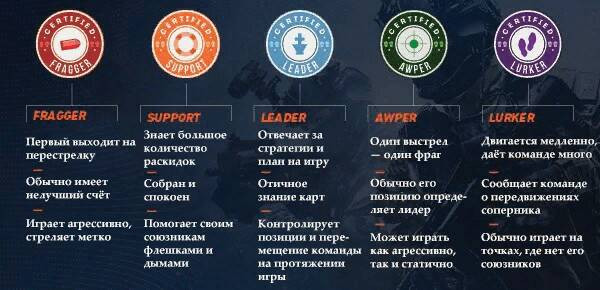
Most names of roles in cs go come from English terms, which is not surprising, given that the English-speaking audience of the game makes up the majority. However, it is not difficult to understand their meanings. The distribution of roles may differ depending on whether the team plays in defense or in attack. In addition, roles can be primary or secondary, since it happens that, along with the main task, one player takes on several additional ones. Professional teams work out action scenarios in advance and think through how each participant will act depending on the situation. But, before delving into such complexities, let's see how the main roles of players in cs go are distributed.
Universal roles
Of course, the team must have a leader who makes decisions and determines the order of actions of the main players. He may be called a captain or an in-game leader (IGL, in-game-leader). He solves the following tasks:
monitors the team’s finances and determines purchases;
determines the overall strategy for the game and adjusts it depending on the actions of the enemy;
determines tactics in difficult situations, for example, during clutches;
gathers information from other team members and immediately uses her.
We can distinguish two main types of in-game leaders depending on how they act in the game. Some go straight into a match with a specific plan, which they discussed with the team, and act in accordance with it. As a result, the team acts more cohesively, but it may lack flexibility, especially if the enemy has had time to study its previous matches. Others prefer to strategize as the game progresses, after seeing what their opponent does in the early rounds. As a rule, they give up a few points at the beginning of the match, but the team has a greater chance of adapting to the opponent’s actions and finding its weak points.
Another universal role that is relevant for both attack and defense – This is a sniper, or AWP-er. He constantly moves around the map so that opponents cannot calculate his position and remove the sniper or take a different route, avoiding the threat. It is clear that the main task of a sniper – destroy as many enemy players as possible. But he can do this in different situations. In defense, he can take on the function of a defensive player for a short time, defending the point, and at the beginning of the round act as an entry-fragger. 800px;">
Roles of players in the attack
If you have to play for the attacking side, the following roles in cs go will be relevant team:
lurker;
entry-fragger;
support.
Let's talk about each of them in more detail. Lurker, from the English lurk (to hide, to hide) – a player who acts secretly and often separately from others. For example, he can distract the enemy’s attention in order to mislead him and prevent him from immediately understanding which point his teammates are about to storm. At the same time, while hiding from the enemy, he can choose the right moment to unexpectedly attack him. But he doesn’t always have to shoot: sometimes his main task is to collect information about the movements of his opponents and pass it on to the players. Regardless of whether the lurker acts aggressively or more secretly, he is required to have excellent knowledge of the map, the ability to remain unnoticed, and also to independently plan his actions.
When discussing roles in cs go and their importance, one cannot fail to mention the entry-fragger. The main qualities of this player – accuracy and reaction speed. His main task – provide your team with a numerical advantage. He is the first to make contact with the opponent and kill at least one player. Consequently, the entry-fragger inevitably acts aggressively and often dies. However, even if his actions lead to a simple trade, his team will receive valuable information about the location of the remaining enemy players.
Another irreplaceable role of a player in cs go is in the attack – support (support), or support player. Between rounds, he spends money not on powerful weapons, but on different types of grenades. In the game, he stays under the cover of other players in order to use a flash grenade in time or create a smoke screen and cover a comrade. In clutch situations, successful actions of a support are often decisive.
Roles in defense
When discussing what roles there are in cs go, it is necessary to separately describe the actions of players in defense, since here the distribution of functions of team members is somewhat different. In defense, responsibilities are distributed less strictly, and there are usually two main roles.
Opornik – a player who remains at a point until the last moment, defending it. Even if it seems that the opponents have decided to attack another site, he will move there only after he is sure that there are no enemy players in his area of responsibility. If an opponent attacked his site, the supporter must hold out as long as possible until the rest of the players on his team arrive.
The task of the helper can be called the opposite. While the defensive player remains on the point for a long time, this player, on the contrary, leaves for another site immediately when it becomes clear that the opponents have begun to attack him.
By studying strategies for different maps, you can find information about which initial distribution is optimal in order to maintain control over both points and have time to react in time to the opponent’s actions.
Minor roles players
The main roles in cs go and their significance were described above, but along with them there are also secondary ones. Unlike the main ones, they are less specific. In addition, depending on the situation, different players can take on them, and there are fewer narrow specializations. Here are some examples of such roles:
Playmaker – A player who acts independently moves around the map alone and tries to find loopholes in the opponent's defense. Often in its functions it is similar to an entry-fragger, but the latter is usually followed by teammates, while the playmaker is usually a loner. With a successful game, the playmaker manages to destroy the opponent’s plans for the round.
Rotator – a defensive player who actively moves around the map can quickly navigate the situation and move from one point to another. Often he acts in contact with the defensive player, if necessary helping him defend the point.
Rifler – a player who achieves great results while playing with automatic or semi-automatic weapons. Often this function is taken over by the same player who plays the role of a sniper in those rounds when he does not have an AWP.
Knowing how the roles of cs go players are distributed in a team, everyone will be able to choose tasks to their liking. By successfully choosing a role, a player can use his strengths, which means he brings maximum benefit to the team.
