


Danger Zone in CS:GO had 15 ranks, from Lab Rat up to The Howl. They were tracked separately from Competitive, depended mostly on wins and did not affect who you were matched against. When Counter-Strike 2 replaced CS:GO on September 27, 2023, the mode was removed, so these ranks are now part of CS:GO history. Below is how the system worked and how players climbed it.
What Danger Zone was
Danger Zone was a battle royale mode added to CS:GO in December 2018, the same day the game went free-to-play. Unlike standard matchmaking, it used its own maps and its own objectives. The goal was to survive, either solo or with a partner. A solo match could hold up to 16 players and a duo match up to 18; a trio option was added later. Alongside regular weapons, the mode had its own unique items, such as tools (a wrench and an axe), mines and breach charges.
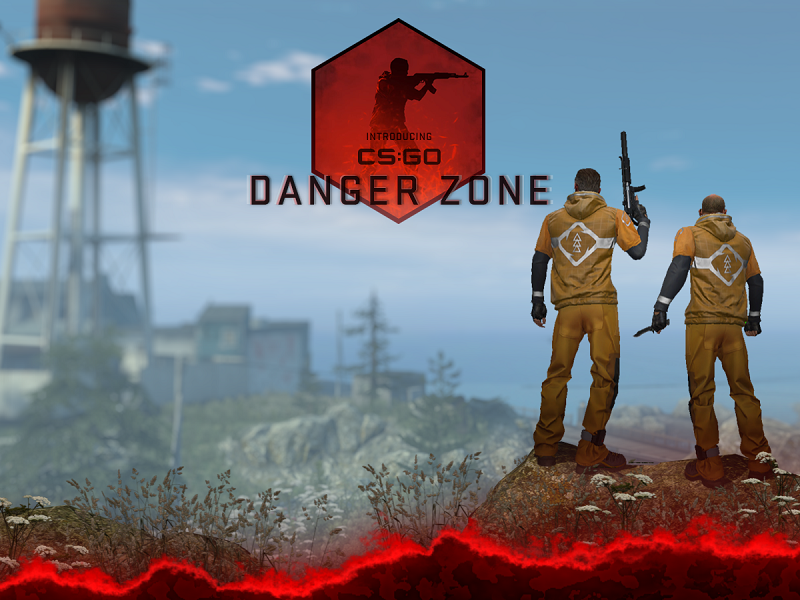
At the start, players parachuted in from helicopters, each into a separate sector, and began searching for gear and other valuables. The safe area shrank over time as a hazard zone spread and damaged anyone caught inside it, so nobody could avoid fights forever. Players could also pick up side missions on the map, such as a contract to eliminate a specific opponent or a hostage extraction. The last player or duo left alive won the match.
Danger Zone used a small set of dedicated maps that rotated from time to time:
Blacksite (the very first Danger Zone map);
Sirocco;
Jungle;
County.
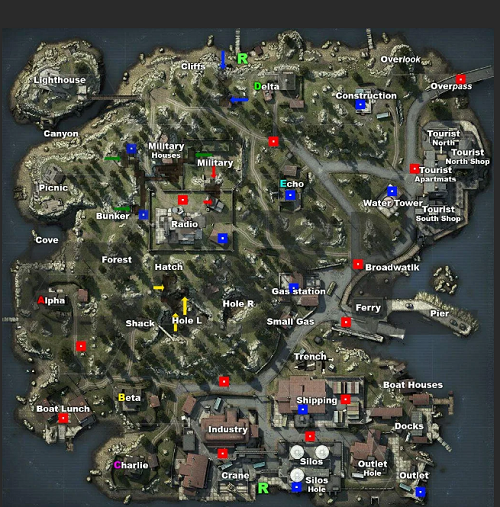
The illustration shows Blacksite as an example.
The mode was very different from the usual terrorists versus counter-terrorists format. Each player fought many opponents at once, so the skills it rewarded were different too. That is why Danger Zone ranks in CS:GO were calculated separately and had their own names. For the other modes of that era, see our overview of CS:GO game modes.
How many ranks Danger Zone had
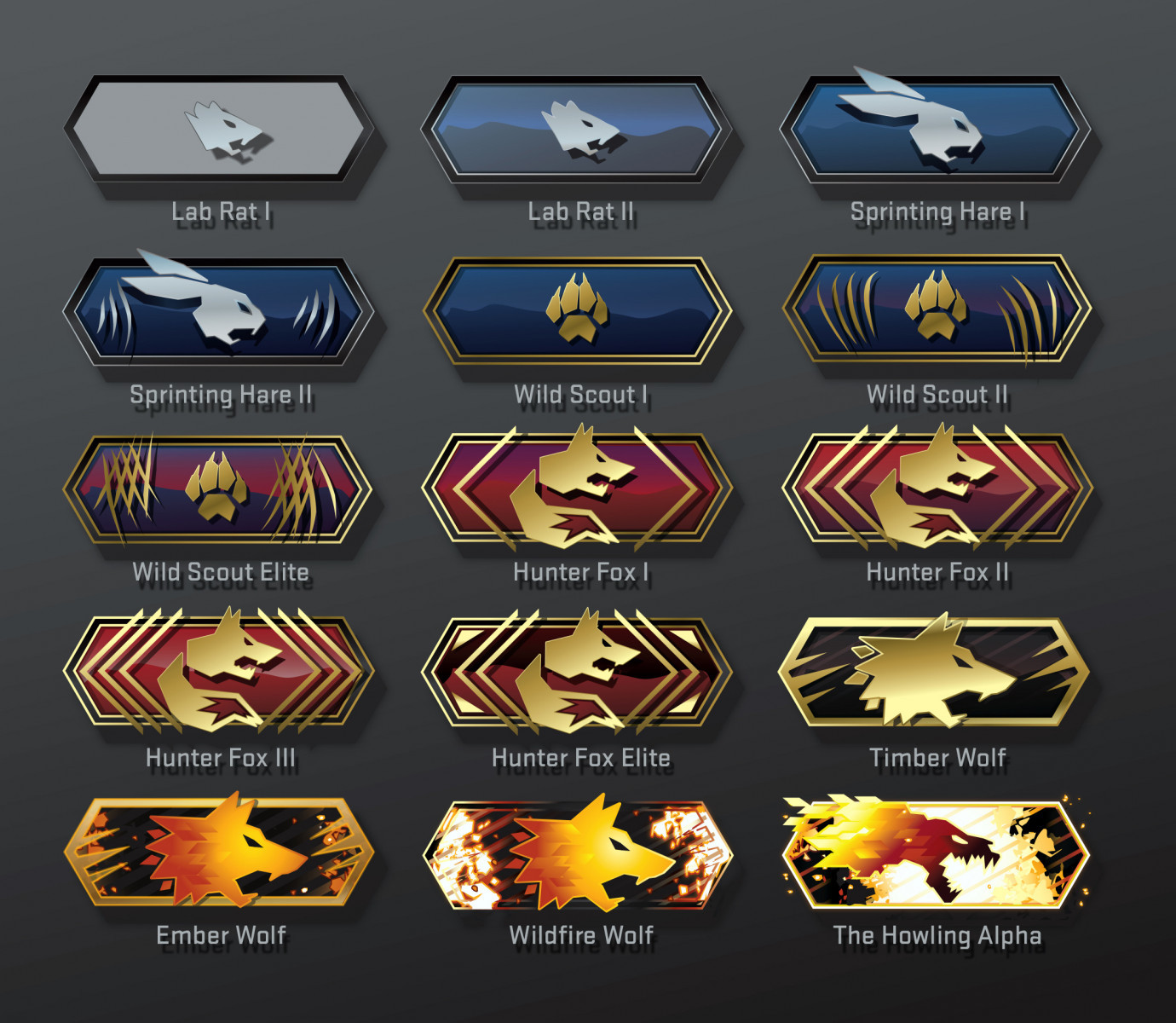
Danger Zone had 15 ranks, all named around the survival theme. They arrived with an update in July 2019. Competitive and Wingman ranks follow military insignia, while Danger Zone used animal symbolism instead. As in other modes, the ranks were grouped into tiers, many of them with several levels:
Lab Rat (2 levels)
Sprinting Hare (2 levels)
Wild Scout (2 levels)
Wild Scout Elite
Hunter Fox (3 levels)
Hunter Fox Elite
Timber Wolf
Ember Wolf
Wildfire Wolf
The Howl
The full list of Danger Zone ranks with their icons is shown below.
What a Danger Zone rank affected
Danger Zone was meant to be played more casually than competitive matchmaking. Competitive demands tight teamwork and can get tense, while Danger Zone was designed as a relaxed alternative for players who wanted variety. As a result, Danger Zone ranks did not affect matchmaking. In Wingman and Competitive, your rank limits the skill range of the opponents you can face so that matches stay balanced. Danger Zone did not use that logic: players of very different levels could land on the same map, and a big skill gap between friends did not stop them from queuing together.
The main factor behind your rating was the number of wins, with other successful actions counted as well. New players had to complete ten calibration matches, after which the system assigned a starting rank (the highest possible after calibration was Hunter Fox III).
How players ranked up in Danger Zone
The way to climb was straightforward: learn the Danger Zone maps and adapt to a changing situation, since every match played out differently. These tips helped players win more often (most of them still apply to any battle royale):
After taking out one enemy, stay alert: someone else may have been tracking the same target. It is easy to lose track of your surroundings while looting a body and get picked off by a more experienced opponent.
Do not chase your favorite weapon. In Danger Zone the more successful players were comfortable with several weapons and made the best use of whatever was available at the moment.
If you are paired with a stranger, split up. If one of you dies, the other is more likely to survive, which keeps the respawn option open. You also know nothing about a random partner's skill, so coordinating can be difficult.
Always carry a stock of health shots and armor. Prioritize other purchases based on the situation.
Keep watching your surroundings whatever you are doing. While you order supplies from the tablet, break loot crates or pick up gear, other players keep moving and can sneak up on you.
Watch the sky so you do not miss supply drops with useful items.
To rank up, especially at lower levels, you did not have to be the last one standing. Dying while among the last few teams still nudged your rating upward.
Ranked Danger Zone required Prime status. Players on the free version of CS:GO could not earn Danger Zone ranks, because they only had access to the unranked mode.
What Danger Zone ranks meant
A Danger Zone rank showed how successful a player was in the mode, but unlike Competitive it had no effect on matchmaking. That is why many players chose Danger Zone when they wanted a relaxed session without arguing with teammates.
Luck also mattered much more in Danger Zone. In competitive matchmaking a match is decided by skill plus some luck, while a battle royale has far more random factors: even if you knew the map perfectly, the loot could simply go against you. So although Danger Zone ranks in CS:GO reflected a player's consistent level, not everyone took them seriously.
What is left of Danger Zone in CS2
CS2 has no Danger Zone mode, so its ranks can no longer be earned or raised. Ranked play now consists of Premier with a numeric CS Rating and Competitive with per-map ranks from Silver I to Global Elite; see our breakdown of how many ranks there are in CS2. The mode lives on through items: skins from the Danger Zone Case are still traded and still drop in CS2. The Danger Zone Case itself costs about $1 on LIS-SKINS, and its two Covert skins, the AK-47 | Asiimov and the AWP | Neo-Noir, start at around $40 and $35 in Field-Tested. For many players these items are the most visible reminder of the battle royale that CS:GO once had.
