


There is no single "FACEIT Trust Factor" in CS2: the term mixes up three separate systems. Valve's Trust Factor is hidden and cannot be checked as a number; you can only infer it from lobby warnings and match quality. FACEIT Finder is an unofficial website that estimates trust from public Steam data, while FACEIT's real behavior rating, the FACEIT Behavior Index (FBI), is visible only to the account owner on their FACEIT profile.
Below we cover how each system works, the ways to check your trust factor that actually exist, how far FACEIT Finder can be trusted, and whether Valve's Trust Factor affects FACEIT matches.
What Is Trust Factor in CS2? Valve's Official System
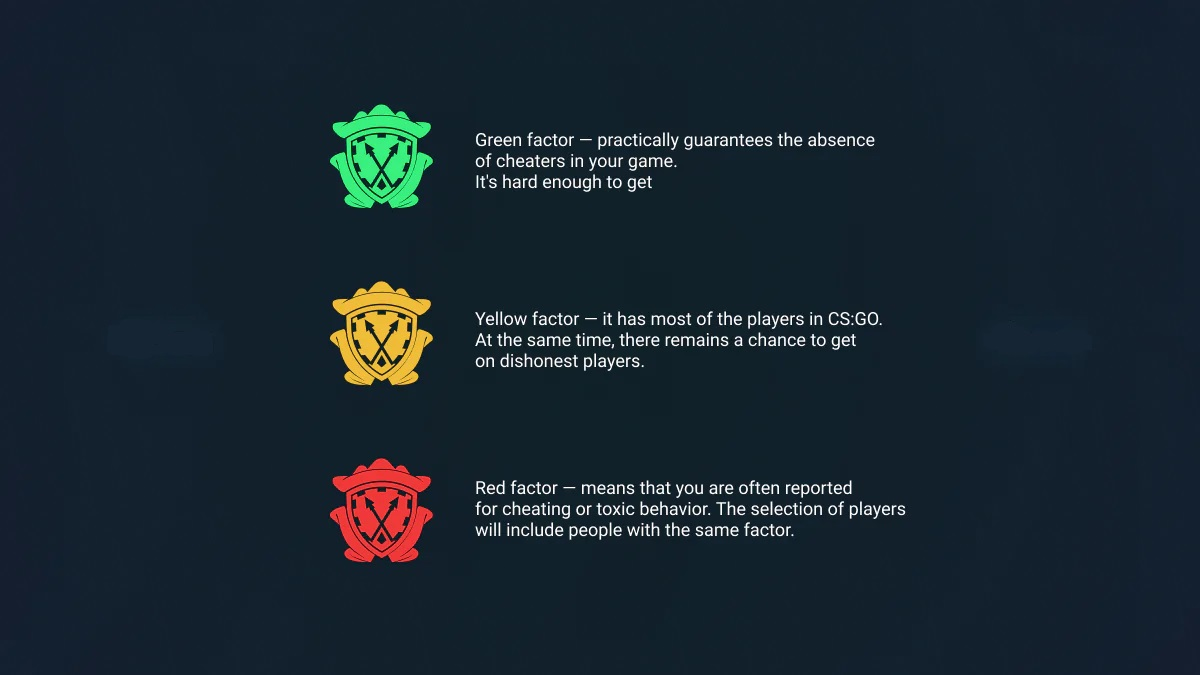
Trust Factor is Valve's official hidden reputation system for regular matchmaking and Premier mode in Counter-Strike 2. Valve introduced it to improve match quality by grouping players with similar trust levels. The exact formula is not public, but the system is known to weigh many behavioral signals.
Trust Factor looks not only at what you do in CS2 but also at your general Steam activity. Players with high trust get matches with fewer cheaters and toxic teammates, while a low Trust Factor means more suspicious accounts and disruptive players. Cheaters in CS2 are also flagged by VACnet and the new Overwatch system.
Based on Steam Support information and community discussions, these are the main factors behind Trust Factor. Valve keeps refining the algorithm and adds new criteria over time.
Table 1: Factors Affecting Valve's Trust Factor
| Factor | Description | Impact |
|---|---|---|
| Player reports | Complaints for cheating, toxicity, griefing | Strongly decreases |
| VAC/Game Ban | Account bans | Critically decreases |
| Account age | Steam profile creation date | Increases with old account |
| Steam activity | Game purchases, profile level, reviews | Moderately increases |
| In-match behavior | Abandons, AFK, team damage | Decreases |
| Friends with bans | Number of banned players in friends list | Moderately decreases |
| Commendations | Praise from other players | Slightly increases |
Valve updates the system regularly. According to players, low Trust Factor warnings returned to the CS2 lobby after the June 12, 2024 update, although Valve did not mention it in the patch notes. That warning before queuing is the only trust signal the game shows directly. Tips on raising it are in our guide on how to increase your trust factor.
FACEIT Finder: an Unofficial Checking Tool
FACEIT Finder (faceitfinder.com) is an unofficial third-party website that tries to rate how "reliable" a player is from public data. It has no connection to FACEIT or to Valve, so a check there gives only a rough estimate based on what is publicly visible.
Its creators built their own algorithm on top of open Steam profile data and FACEIT statistics. It assigns a level from 0 to 3 or a "trust" percentage. Many players take this number as official, but it is only an independent reading of public information.
According to Steam Community discussions, the algorithm is simple: it collects the account creation date, hours played, achievements, the friends list and bans among friends, then turns them into a single score.
Table 2: Trust Factor Levels in FACEIT Finder
| Level | Percentage Range | What It Means |
|---|---|---|
| 0 | 0-25% | Very suspicious account, new profile or many bans in friends |
| 1 | 26-50% | Low trust, possible activity problems |
| 2 | 51-75% | Average level, regular player without special problems |
| 3 | 76-100% | High trust, old account with good history |
Steam Community users note that FACEIT Finder often shows 0% for accounts without a FACEIT profile, and it can rate private profiles low even when the player is perfectly clean. So a CS2 trust factor check on this site is indicative at best.
How to Check Trust Factor Through FACEIT Finder?

A FACEIT Finder check takes a few seconds. You do not need to register or share any personal data; a public Steam profile is enough for the tool to collect what it needs.
To check a trust score on FACEIT Finder:
Open faceitfinder.com in any browser. The main page has a search bar for player data.
Paste the player's Steam profile link or Steam ID. The site accepts a full profile URL, SteamID64, SteamID3 or a custom URL.
Click search and wait a few seconds for the results.
Review the results: the "trust" percentage, FACEIT statistics (if the player has an account), bans among friends and other data.
The results page shows the Steam account creation date, CS2 hours, any VAC bans, the number of banned friends and FACEIT statistics. Hovering over the "trust" bar reveals the exact number.
Keep in mind that FACEIT Finder reads only public data. If a Steam profile is private, the tool may show 0% or a wrong result. That says nothing about the player's reputation; the site simply cannot see enough to calculate a score.
How Accurate Is FACEIT Finder Trust Factor?
Experienced CS2 players have serious doubts about FACEIT Finder's accuracy. Many Steam Community threads show that its numbers often do not match Valve's real Trust Factor: players report seeing 100% on FACEIT Finder while the lobby showed a red low trust warning for that same teammate.
One user described an account rated 7% on FACEIT Finder that still got excellent matches in official matchmaking. Another got a low trust warning for a teammate whose FACEIT Finder score was higher than his own. Both cases show how unreliable the third-party score is.
The core problem is limited data. The site cannot see Valve's internal records of reports, in-match behavior or VAC checks, so it relies on surface signals like hours, account age and the friends list. Valve's system is far more complex and uses many hidden parameters.
Key FACEIT Finder limitations:
No access to Valve's internal data about reports and violations.
Doesn't account for in-match behavior history in Counter-Strike 2.
Doesn't analyze suspicious gameplay patterns or statistics.
Shows 0% for private profiles and accounts without FACEIT.
Not connected to official Valve or FACEIT systems.
In Steam discussions, users call FACEIT Finder "completely useless" and say it "has no connection" to Valve's Trust Factor. One player explained that the site mostly looks at hours over the last two weeks, the share of banned friends and how achievements were earned, and that too many or too few recent hours lower the score automatically.
FACEIT Behavior Index (FBI): the Official FACEIT System

Unlike FACEIT Finder, the FACEIT Behavior Index, or FBI, is FACEIT's own official behavior rating. The FACEIT team introduced it in November 2016 as a numeric index that reflects each player's overall conduct on the platform.
Every new player starts at 1000 points, and the algorithm keeps updating the index from several data sources. FACEIT's data science team worked on it for more than a year using statistics from tens of millions of matches; the result works much like a karma system in online communities.
According to FACEIT's documentation, the FBI takes into account post-match reports, AFK and abandon detection, skill, the number of matches played and other inputs. It looks at recent trends as well as overall history, which lets it react quickly to a spike of bad behavior with warnings or cooldowns.
You can check your official FBI only on your own profile on the FACEIT website (if you do not have an account yet, start with registering on FACEIT). The index is visible only to the owner and hidden from other players to keep the system anonymous and harder to game. The profile shows both the overall index and a rating for your last three matches.
Table 3: FACEIT Finder vs FACEIT Behavior Index Comparison
| Parameter | FACEIT Finder | FACEIT Behavior Index (FBI) |
|---|---|---|
| Official status | Unofficial third-party site | Official FACEIT system |
| Data access | Only public Steam information | Full FACEIT platform data |
| Rating scale | 0-3 levels or 0-100% | Numerical index from 0 to ~1500+ |
| Visibility | Public for everyone | Visible only to owner |
| Game impact | None | Direct (warnings, bans, queue access) |
| Data source | Steam profile + FACEIT stats | Reports, AFK, abandons on FACEIT |
The FBI has a real effect on your FACEIT experience. According to FACEIT, players with a high index (above 1150) get access to premium queues and other perks, while a low FBI triggers automatic restrictions, from warnings to temporary suspensions. Under the platform's rules at the time of writing, cooldown length depends on violations in the last 14 days (violations × 3 × 30 minutes). Besides behavior, playing on FACEIT also requires the FACEIT anti-cheat to be running.
Does Trust Factor Affect FACEIT Games?
Valve's Trust Factor has no effect on FACEIT matches. The two systems are fully independent: Trust Factor works only in official CS2 matchmaking, that is Premier and regular Competitive. When you play a match through FACEIT, Valve's system is not involved.
FACEIT runs its own servers and matchmaking, built on its ELO rating and the FACEIT Behavior Index, plus your skill level and region. Valve's Trust Factor plays no part in these calculations.
Some players believe that keeping the FACEIT anti-cheat running during official matchmaking can hurt Trust Factor. Opinions in Steam Community differ: one user said his trust factor dropped after a month of MM with FACEIT AC running, while others point out that FACEIT AC is legitimate software and should not affect Valve's system.
Here is how the two systems split:
Official Valve matchmaking (Premier/Competitive):
Uses Valve Trust Factor.
Analyzes Steam and CS2 behavior.
Accounts for VAC status and reports in official matches.
Only affects official matchmaking quality.
FACEIT Platform:
Uses FACEIT Behavior Index (FBI).
Analyzes behavior only on FACEIT platform.
Accounts for reports, AFK and abandons in FACEIT matches.
Only affects FACEIT gaming experience.
FACEIT servers are VAC-secured, so Valve's systems still see player activity there, but for other purposes. Reports for griefing or toxicity may feed into Trust Factor for official matchmaking, yet Valve's Trust Factor itself never carries over to FACEIT.
Practical Conclusions for Players

A single system called "FACEIT Trust Factor in CS2" does not exist. There are three different mechanisms: Valve's official Trust Factor for CS2 matchmaking, the unofficial FACEIT Finder for a rough account estimate, and the official FACEIT Behavior Index for the FACEIT platform.
Know each tool's limits. FACEIT Finder gives only a rough estimate from public data and does not reflect Valve's real Trust Factor. Your actual reputation in official matchmaking stays hidden; you can judge it only by lobby warnings and the quality of your matches.
The advice for every system is the same: play fair, avoid toxic behavior and abandons, keep an active, long-standing Steam account and do not add banned players as friends. These simple rules keep your trust high both in official matchmaking and on FACEIT.
FAQ
How do I check my Trust Factor in CS2?
There is no official way to see Valve's Trust Factor as a number. The low trust warning in the lobby and the quality of your matches are the only indirect signals. Sites like FACEIT Finder show their own estimate from public Steam data, which does not match Valve's system.
Is FACEIT Finder an official FACEIT tool?
No. FACEIT Finder is a third-party website with no connection to FACEIT or Valve. Its 0 to 3 levels and percentages are its own interpretation of public data.
Where can I see my FACEIT behavior score?
The official FACEIT Behavior Index is visible only to you, on your own profile on the FACEIT website. Other players cannot see it.
Does Valve Trust Factor affect FACEIT matches?
No. FACEIT matchmaking uses ELO and the FBI, while Trust Factor applies only to official CS2 matchmaking (Premier and Competitive).
